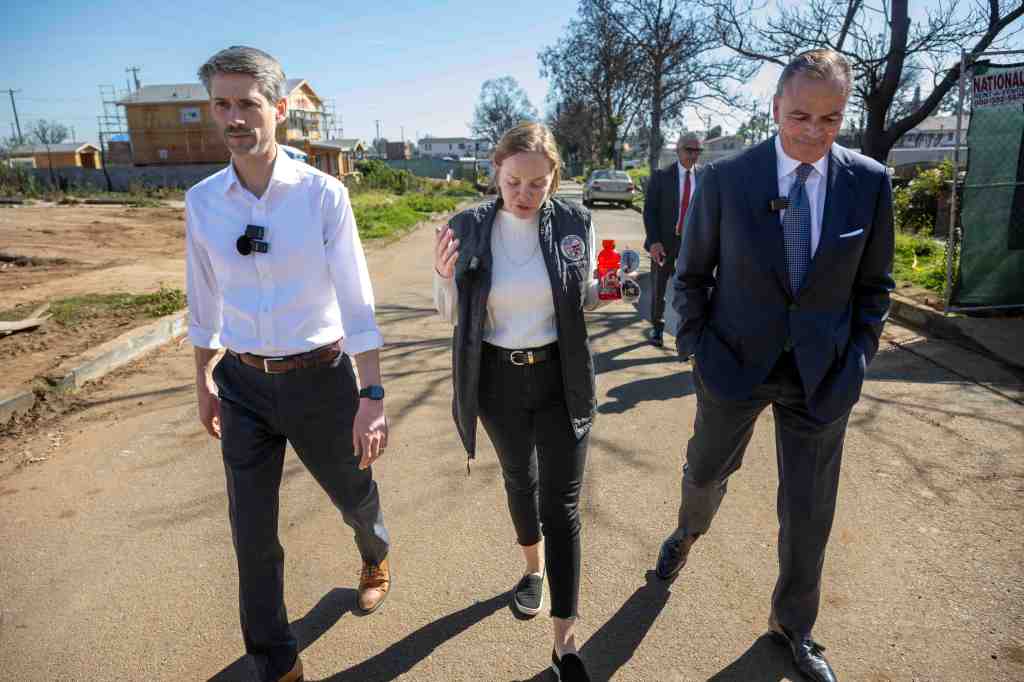
San Jose Mayor Matt Mahan walked through blocks of cleared foundations and hollowed lots in Pacific Palisades alongside developer Rick Caruso and Los Angeles Councilmember Traci Park on Thursday, Feb. 26, confronting first-hand what residents say has become a prolonged and fragmented recovery process more than a year after the fire.
The walking tour began at LAFD Station 69 and moved through a corridor that has come to symbolize California’s wildfire rebuilding challenge. Nearly 6,000 properties sit in various stages of insurance dispute, debris clearance, redesign or financing limbo. What has stalled progress, residents say, is not a lack of will, but a lack of coordination, capital flow, clear accountability and the critical question around insurance.
The most consequential part of the visit did not happen on the walking tour, but behind closed doors, where Mahan — a candidate for governor of the state who even as a moderate Democrat has emerged as a vocal critic of Gov. Gavin Newsom — joined nearly 40 Palisades and Malibu stakeholders for a recovery and resilience roundtable convened by Palisades Recovery Coalition, led by founder and president Maryam Zar.
-
California gubernatorial candidate and San Jose Mayor Matt Mahan, during a roundtable with Palisades Fire survivors and community leaders in Pacific Palisades
on Thursday, February 26, 2026. (Photo by Hans Gutknecht, Los Angeles Daily News/SCNG)


1 of 11
California gubernatorial candidate and San Jose Mayor Matt Mahan, during a roundtable with Palisades Fire survivors and community leaders in Pacific Palisades
on Thursday, February 26, 2026. (Photo by Hans Gutknecht, Los Angeles Daily News/SCNG)
What unfolded was less a political stop and more a systems-level briefing, a detailed diagnosis of where many say California’s wildfire recovery model is breaking down, more than a year out from the Jan. 7, 2025 disaster that killed 12 people and destroyed thousands of structures in the coastal area from L.A.’s Palisades to Malibu.
From the outset, one issue dominated the conversation: insurance. Residents, recovery practitioners and finance professionals described an insurance market in retreat.
Nonrenewals and cancellations have surged, and premium increases exceeding 90% have become common.
Court Wagner, a resident with a home still standing who’s part of the community advisory group, explained how even fully insured homeowners are carrying $400,000 to $500,000 in out-of-pocket exposure because insurance proceeds do not align with construction timelines or mortgage requirements.
Jerolin “Jere” Ashby, a fourth-generation Palisadian and Palisades Recovery Coalition volunteer, described the monthslong scope of work disputes that leave families trapped between adjusters, contractors and lenders, unable to move forward despite having coverage on paper.
Participants returned to the same reality that money is the driver of a community coming back. Without predictable capital flow, people cannot rebuild and neighborhoods cannot stabilize.
Councilmember Park said that for many residents, insurance complications have been more destabilizing than total loss.
“The people in the Palisades who did not lose their homes have said to me more times than I can count that they almost wish they had,” Park said. “Dealing with insurance companies on damage claims has been one of the most frustrating and difficult elements of this entire process.”
She emphasized that what many homeowners are facing is not cosmetic repair, but major reconstruction. “For some families, remediation means taking homes down to the studs,” Park said. “This is not sending in a cleaning crew. This is invasive, complex work, and insurance has not been set up to deal with that reality.”
Stakeholders argued that the problem is not simply insurer reluctance, but a structural mismatch between how insurance functions and how rebuilding actually happens. Claims are handled transactionally. Rebuilding is phased, dynamic and interconnected. Homeowners are left to mediate a system that was never designed for neighborhood-scale disasters.
Zar, a key community convener, raised a deeper governance concern.
While residents and local leaders are quietly organizing block-by-block conversations around resilience, undergrounding utilities, vegetation management and evacuation routes, it is the insurance industry — which ultimately determines affordability and insurability — that is not present in those discussions.
“If we are not bringing insurers into the room,” one participant said, “we are designing recovery without the market that determines whether people can afford to stay.”
Insurance instability was repeatedly linked to unresolved infrastructure vulnerabilities.
Jeff Skaggs, Decision Construction founder and president, who is leading undergrounding initiatives across Pacific Palisades, Malibu and Altadena, pointed to the history of utility-caused ignitions in high fire severity zones.
Skaggs noted that the L.A. Department of Water and Power did not implement power shutoffs during the fire despite red flag conditions. Michel Shane, a Malibu resident and Pacific Coast Highway safety advocate who founded Emily Shane Foundation named after his daughter who lost her life on PCH, emphasized that Southern California Edison has already begun undergrounding in comparable corridors because long-term economics favor prevention over repeated disaster response.
Speakers warned that rebuilding beneath overhead power lines in high-risk areas undermines long-term insurability. Infrastructure decisions, they argued, are insurance decisions. Without modernized utilities, insurers will continue to retreat and premiums will continue to rise.
Park underscored that recovery requires centralized operational planning, not just individual approvals. “Recovery is operations, logistics, traffic management, sequencing; all the pieces,” she said. “That is why we opened a one-stop shop for city departments right here in the heart of the Palisades, so residents are not bouncing between agencies.”
As he walked the burn area with Mahan, Caruso, a centrist-Democrat who said in January that he will not run for governor, was blunt about what he believes is missing.
“What we do not have is a recovery czar,” Caruso said. “That role has not been replaced in over a year. Someone was in it for only six months. There needs to be an overall logistics plan in place.”
Caruso said rebuilding thousands of homes simultaneously requires professional level coordination.
“Right now, things are working reasonably well. But when more and more homes get under construction, just the sheer logistics; undergrounding, water, traffic; all of it has to come together.”
The financial paralysis has been compounded by stalled federal funding.
“The single biggest thing is to get those FEMA dollars to flow,” Mahan said following the tour. “The state has already allocated a billion dollars that are not being deployed, in part because we are waiting on federal dollars. We need to get going now.”
Asked whether strained relations between Newsom and President Donald Trump were contributing to delays, Mahan declined to speculate but emphasized responsibility.
“I have not been in the room,” he said. “But as governor, I will do what it takes to get federal dollars to flow here. I will go to Washington and make it a win-win for the president to rebuild this community. That is our job in government; to set politics aside and deliver for the people.”
Roundtable participants suggested that federal disaster dollars could serve as a stop-gap capital layer, potentially backed by private investment, to bridge the timing mismatch between insurance payouts and rebuilding costs. Without that bridge, neighborhoods remain frozen while families exhaust savings.
Land management failures also featured prominently.
Tracy Price, a multigenerational Palisades resident, described how historic fuel break programs and mechanical clearing on adjacent lands were discontinued decades ago. Stakeholders called for a state-led vegetation management model in high-fire-severity zones that integrates controlled burns, mechanical thinning and targeted grazing, paired with insurance incentives and infrastructure upgrades.
Mahan acknowledged the imbalance in state priorities.
“We spend roughly $8 on suppression for every dollar on prevention,” he said. “That has to change.”
Public safety concerns extended beyond vegetation. Court Wagner and Tony Yorkton described what they characterized as a near mass casualty scenario during the fire, citing insufficient evacuation planning under red flag conditions. Participants called for state-guided best practices that extend beyond ignition, including multi day monitoring, pre cleared fire breaks, expanded evacuation zones, and coordinated communications.
Across every topic — insurance, infrastructure, federal funding, land management, evacuation — one question kept resurfacing.
“I kept asking, who is the quarterback?” Mahan said. “Nobody seems to know who is actually responsible for coordinating all the different levels of this work.”
Residents want clarity on undergrounding timelines, road repaving, environmental health standards, and why thousands of structures are being rebuilt as isolated projects rather than coordinated neighborhoods.
Mahan, the mayor of San Jose since 2023 who is part of a large field of a dozen Democrats with no frontrunner, said that as governor he would appoint a point person to coordinate federal, state, local and private-sector actors.
“You need a single point of accountability,” he said. “You need insurance companies at the table. They need to pay out claims or see us in court. But we also have to fix the insurance market statewide. It is not feasible to ask companies to provide coverage at a loss consistently. The state needs to step up and play its role. We have to take responsibility, learn the hard lessons, and not allow this to happen again.”
Park said Mahan’s decision to walk the burn zone and sit through the roundtable mattered to residents who have felt unheard.
“I really appreciate that he is making the time to get to know this community and understand the very special challenges we face,” she said. “There is a real reliance on the state to help us get this community where it needs to be so people can come home.”
She added that the stakes extend far beyond the neighborhood. “Palisades recovery is Los Angeles recovery,” Park said. “And Los Angeles recovery is California recovery. If we do not get this right here, we are not going to get it right elsewhere.”
Caruso framed the visit as evidence of engagement rather than symbolism. “He is the only candidate who has come down and walked the burn areas, listened to the people, and understood it,” Caruso said. “He is also the only candidate who has a track record of success on both the private- and public-sector side. What he has done in San Jose can be scaled up statewide.”
For Palisades and Malibu residents, however, the political implications matter less than the timeline. Insurance remains unstable. Federal dollars remain delayed. Infrastructure decisions remain unresolved. Environmental health standards remain unclear. Thousands of structures remain in limbo.
The roundtable ended not with sweeping promises, but with defined next steps; insurance and financing recovery labs, undergrounding and infrastructure dossiers, vegetation management pilots, and governance concept proposals.
Pacific Palisades is no longer simply rebuilding after a fire. It has become a statewide test of whether California can align insurance markets, infrastructure modernization, federal funding, land management and governance into a coherent recovery strategy.